
Box truck weight limits are one of the most misunderstood parts of commercial driving. Many drivers focus on space, but weight matters just as much. Going over the legal limit can lead to fines, safety risks, and serious damage to the truck. Understanding box truck weight limits helps you protect your cargo, your license, and your business.
This guide explains weight limits in plain language. You will learn how weight is measured, how different box truck sizes compare, and what the law requires. If you want clear facts without confusion, this guide is for you.
Box Truck Weight Limits and GVWR
GVWR stands for Gross Vehicle Weight Rating, and it’s the most important number you need to know about your box truck. This rating tells you the maximum total weight your truck can safely handle when it’s fully loaded. The GVWR includes everything: the truck itself, the driver, passengers, fuel, and all the cargo you’re hauling.
Every box truck has a GVWR assigned by the manufacturer based on the vehicle’s design, frame strength, suspension system, and braking capacity. You’ll find this number on a sticker inside the driver’s side door frame or in your owner’s manual. This isn’t a suggestion—it’s a hard limit set for safety.
Here’s how GVWR works in practice. If your box truck has a GVWR of 14,000 pounds and the empty truck weighs 8,000 pounds, you can only load 6,000 pounds of cargo. That 6,000 pounds includes everything you put in the truck bed, plus the weight of fuel, the driver, and any passengers. Go over that limit, and you’re breaking the law and risking serious safety issues.
Understanding your GVWR helps you plan jobs better. When you know exactly how much weight your truck can handle, you can avoid overloading and make smarter decisions about what equipment or materials to bring on each trip. The curb weight (empty weight) of your truck is subtracted from the GVWR to give you your actual payload capacity.
The difference between GVWR and actual payload capacity confuses many people. Your payload is what you can actually haul after accounting for the truck’s own weight. A 26,000-pound GVWR doesn’t mean you can load 26,000 pounds of junk or furniture. If the truck weighs 14,000 pounds empty, you only have 12,000 pounds available for cargo.
Why GVWR Matters for Your Safety
Exceeding your GVWR creates multiple dangers. Your brakes take much longer to stop the vehicle. The tires can overheat and blow out, especially on highways or in summer heat. Your suspension system gets damaged faster, leading to expensive repairs. Steering becomes harder, and the truck doesn’t handle turns or lane changes well.
Insurance companies won’t cover accidents that happen when you’re overweight. If you crash while hauling more than your GVWR allows, you’re personally responsible for all damages. Police can impound your truck at the scene, and you’ll face fines that start at several hundred dollars and go up from there.
Box Truck Weight Classifications
Box trucks fall into different weight classes based on their GVWR. The U.S. Department of Transportation uses these classifications to set regulations and requirements. Knowing which class your truck falls into helps you understand what rules apply to you.
Light-Duty Box Trucks (Class 1-3)
These are the smaller trucks you see for local deliveries. They drive a lot like a big SUV or a pickup truck.
- Class 1: These are very small, usually under 6,000 pounds. Most box trucks start higher than this.
- Class 2: These weigh between 6,001 and 10,000 pounds. Many “step vans” or small delivery trucks are in this group.
- Class 3: This is a very common group. These weigh between 10,001 and 14,000 pounds. These are often called light-duty box trucks. They are great for small jobs because they can fit into tight driveways.
Medium-Duty Box Trucks (Class 4-6)
This is where most box trucks live. If you rent a truck to move your house, it will likely be in this group.
- Class 4: 14,001 to 16,000 pounds. These are getting bigger and often have dual rear wheels to help hold the weight.
- Class 5: 16,001 to 19,500 pounds.
- Class 6: 19,501 to 26,000 pounds. This is a huge category. Most 26-foot trucks are built to be right at 26,000 pounds. This is because of a special rule about licenses that we will talk about later.
Heavy-Duty Box Trucks (Class 7-8)
These are the giants of the box truck world.
- Class 7: 26,001 to 33,000 pounds. These trucks are very big and very strong.
- Class 8: Anything over 33,001 pounds. While most Class 8 trucks are semis, some very large straight trucks (trucks where the box and engine are on one frame) fall here.
When you look for the weight limit for box truck use, you must know your class. It tells you if you have to stop at scales or if you need special insurance. It also changes how much you pay for tags and plates.
Different Types of Box Trucks, Weight Limits, and Sizes
The size of the box on the back usually tells you how much it can carry, but not always. You have to look at the box truck sizes and the frame separately. A long truck doesn’t always carry more weight than a short one; it might just have more room for light things like pillows.
10 Foot Box Truck
This is the smallest size. It is great for a studio apartment or a small office move. It is often built on a van frame.
- Average GVWR: Around 8,600 to 10,000 lbs.
- Cargo capacity: About 2,000 to 3,000 lbs.
- Cargo volume: You have about 400 cubic feet of space.
- Best use: Picking up a new couch or moving a dorm room.
12 Foot Box Truck
A step up from the 10-footer. It is a bit wider and taller.
- Average GVWR: 10,000 to 12,000 lbs.
- Payload capacity: roughly 3,000 to 4,000 lbs.
- Loading space: Good for a 1-bedroom apartment.
- Fact: These are very popular for “last-mile” delivery because they can park in normal spots.
16 Foot Box Truck
This is a very popular size for local businesses. The 16ft box truck weight limit is usually around 12,500 to 14,500 lbs for the GVWR.
- Max weight for box truck (16ft): You can usually haul about 4,000 to 6,000 lbs of cargo.
- Floor space: About 120 square feet.
- Class: Usually a Class 4 truck.
20 Foot to 24 Foot Box Truck
These are medium-sized trucks used for bigger moves. They are often called medium-duty box trucks.
- Average GVWR: 15,000 to 22,000 lbs.
- Weight capacity: These can often carry 6,000 to 10,000 lbs of items.
- Box truck dimensions: The box is usually 8 feet wide and 8 feet tall. This makes it easier to stack items high.
26 Foot Box Truck
This is the biggest truck you can usually drive without a special “big truck” license.
- Maximum box truck weight: Usually capped at 26,000 lbs GVWR.
- Empty weight: These trucks are heavy because they are so big. They might weigh 13,000 to 15,000 lbs empty.
- Cargo capacity: This leaves you about 10,000 to 12,000 lbs for your stuff.
- Note: If you add a “liftgate” (the metal platform that helps lift heavy things), that takes away from your weight limit. A liftgate can weigh 1,000 pounds!
| Truck Size | Average GVWR | Est. Empty Weight | Est. Payload |
| 10 Foot | 9,900 lbs | 7,100 lbs | 2,800 lbs |
| 12 Foot | 11,000 lbs | 7,500 lbs | 3,500 lbs |
| 16 Foot | 14,500 lbs | 9,000 lbs | 5,500 lbs |
| 20 Foot | 19,500 lbs | 11,000 lbs | 8,500 lbs |
| 24 Foot | 26,000 lbs | 13,500 lbs | 12,500 lbs |
| 26 Foot | 26,000 lbs | 14,500 lbs | 11,500 lbs |
What is a CDL? Do I Need a CDL to Drive a Box Truck?
A Commercial Driver’s License (CDL) is a special license required to operate certain large vehicles. The CDL requirements depend primarily on the GVWR of the vehicle you’re driving and what you’re hauling.
The 26,000-Pound Rule
Here’s the simple rule: if your box truck has a GVWR of 26,000 pounds or less, you don’t need a CDL. Your regular driver’s license is enough. This is why so many box trucks are designed with a GVWR of exactly 26,000 pounds—manufacturers build them right up to that limit to maximize capacity without requiring special licensing.
However, you do need a CDL if your box truck weighs more than 26,000 pounds GVWR. You also need one if you’re towing a trailer that weighs over 10,000 pounds, even if the truck itself is under 26,000 pounds. The Gross Combined Weight Rating (GCWR) matters in these situations.
Types of CDL Licenses
There are three main types of CDLs, each covering different vehicle categories.
- A Class A CDL is required for combination vehicles where the total weight exceeds 26,000 pounds and the towed vehicle is over 10,000 pounds. This applies to semi-trucks pulling trailers but rarely affects box truck operators unless you’re towing heavy equipment.
- A Class B CDL covers single vehicles with a GVWR over 26,000 pounds, like heavy-duty box trucks. This is what you need if you’re driving a larger straight truck or cube truck that exceeds the 26,000-pound limit. The test includes a skills assessment in the actual type of vehicle you’ll drive.
- A Class C CDL is needed for vehicles carrying hazardous materials or transporting 16 or more passengers. Even if your box truck is under 26,000 pounds, you need this license if you’re hauling hazmat loads.
Getting Your CDL
- Study and Written Test: Read your state manual and pass a DMV exam on safety, truck laws, and official DOT rules.
- Get Your Permit: After passing the written test, you receive a learner’s permit to practice driving with a licensed pro in the passenger seat.
- Professional Training: Finish an “Entry-Level Driver Training” program at a truck school or an approved company program.
- The 3-Part Skills Exam: Pass a hands-on test that covers truck inspections, parking drills, and driving in real traffic.
- Time and Budget: Plan for the process to take about 3 to 8 weeks and cost between $3,000 and $7,000.
- Tuition Help: Many employers will pay for your school if you agree to drive for them for a set amount of time.
State-Specific Rules
Some states have additional rules about commercial use versus personal use. Even with a truck under 26,000 pounds, some states require special endorsements or a non-CDL commercial license if you’re using the vehicle for business purposes.
A few states require medical certification even for non-CDL commercial drivers. This involves a physical exam by a DOT-certified medical examiner. You’ll need to pass vision, hearing, and blood pressure tests, among other health checks.
Always check your state’s specific CDL requirements before starting a commercial hauling operation. What applies in one state might differ in another, especially if you plan to cross state lines for work.
State and Federal Box Truck Weight Limits & Regulations
Commercial truck weight limits are set at both federal and state levels, and you need to follow both sets of rules. Federal regulations establish baseline standards that apply nationwide, while states can add their own restrictions on top of those.
Federal Weight Limits
The federal government sets maximum weight limits for different axle configurations through the Federal Highway Administration. These rules apply to all vehicles operating on interstate highways.
- A single axle can legally carry up to 20,000 pounds. This applies to one axle with one or two tires on each end. Most box trucks have a single rear axle, so this limit is crucial for proper loading.
- A tandem axle setup can handle up to 34,000 pounds. Tandem axles have two axles close together, spreading the weight over four or more tires. Larger box trucks and most semi-trailers use tandem axles for better weight distribution.
- The steering axle specifically is limited to 12,000 pounds to ensure proper vehicle control. This is the front axle that turns when you steer. Overloading the steering axle makes the truck hard to maneuver and increases accident risk.
Federal Bridge Formula
This rule makes sure your weight is spread out across the wheels. If too much weight is in one small spot, it can crack a bridge or damage the road. Most trucks are built to pass this rule, but you must be careful if you change the truck’s frame.
Maximum Gross Weights
The biggest trucks on the highway can weigh up to 80,000 pounds. Most box trucks are much lighter, but you need to watch this total weight if you are towing a heavy trailer behind you.
State Weight Limits and Restrictions
Every state has its own laws. Some roads have lower limits during the spring when the ground is soft. You might need a special paper (a permit) to drive a heavy load through certain areas.
Weigh Stations and Enforcement
These are check-points on the highway where the police weigh your truck. Some stations have sensors that weigh you while you drive, and they will pull you over if the sensors say you are too heavy.
Penalties for Violations
If you are overweight, the police will give you a ticket that can cost thousands of dollars. They might even make you park the truck and move your boxes to a different vehicle before you can leave. Staying legal keeps your driving record clean and keeps your costs low. At Junk Masterz, we follow these rules to make sure we can keep serving our customers without any trouble from the law.
How to Calculate Your Box Truck’s Payload Capacity
Calculating your payload capacity is straightforward once you know the right numbers. This calculation tells you exactly how much cargo you can legally and safely load. Many people skip this step and guess, but accurate calculations prevent overloading and legal problems.
Step 1: Find Your GVWR
Start by locating your truck’s GVWR. This number appears on a certification label inside the driver’s side door frame. The label includes other important information like tire pressure recommendations and manufacturing details, but GVWR is what you need first.
If you can’t find the door label or it’s damaged, check your owner’s manual. The GVWR is listed in the specifications section. You can also contact the manufacturer with your vehicle identification number (VIN) to get this information.
Step 2: Determine Curb Weight
Your truck’s curb weight is how much it weighs empty with a full tank of fuel. This is also called the empty weight or unloaded weight. The door label sometimes includes this number, but it’s not always listed.
The most accurate way to find curb weight is to drive your empty truck to a certified scale. Truck stops, recycling centers, and some hardware stores have scales. Make sure the fuel tank is full when you weigh the truck, because fuel adds significant weight.
A gallon of gasoline weighs about 6.3 pounds, and a gallon of diesel weighs about 7.1 pounds. If your truck has a 50-gallon tank, that’s 315-355 pounds of fuel weight that counts toward your total.
Step 3: Calculate Basic Payload
Now for the math: subtract the curb weight from the GVWR. This gives you your gross payload capacity.
GVWR – Curb Weight = Gross Payload Capacity
For example, if your truck has a GVWR of 16,000 pounds and weighs 10,000 pounds empty with fuel, your gross payload is 6,000 pounds.
Step 4: Account for Driver, Passengers, and Equipment
You’re not finished yet. The gross payload includes everything that goes in or on the truck. You need to subtract the weight of the driver, any passengers, and tools or equipment that stays in the truck.
An average adult weighs about 180-200 pounds. If you typically work with a helper, that’s two people at roughly 400 pounds total. If you carry 300 pounds of tools, ramps, dollies, straps, and other equipment, that’s another 300 pounds.
In our example, you’d subtract 700 pounds from your 6,000-pound gross payload:
6,000 pounds – 700 pounds = 5,300 pounds net cargo capacity
This 5,300 pounds is your real working capacity for hauling junk, furniture, or other cargo.
Step 5: Verify with Actual Weighing
The best practice is to weigh your loaded truck at a certified scale before departing, especially when you’re hauling near your maximum capacity. This confirms you’re legal and safe.
Many truck stops charge $10-$15 for a weigh ticket. This small cost is worth it compared to a $500+ overweight fine or the danger of brake failure.
Common Calculation Mistakes
People often forget to include fuel weight in their calculations. An empty tank versus a full tank makes a 300-400 pound difference on most box trucks.
Another mistake is not accounting for permanent equipment. If you installed shelving, tool boxes, or a liftgate, these permanently add to your curb weight and reduce your available payload.
Some operators forget that cargo weight isn’t just the items themselves. Packing materials, pallets, and securing equipment all count toward your total load.
Proper Loading Techniques and Best Practices
How you load your box truck affects safety, cargo protection, and vehicle performance. Poor loading causes accidents, damages goods, and wears out your truck faster. Follow these best practices to load safely and efficiently every time.
- Weight Distribution: Place heavy items on the floor and toward the center. Keep the weight even from side to side and front to back to keep the truck stable and easy to steer.
- Loading Order: Put big, heavy items against the front wall first. Fill gaps with small boxes to prevent sliding, and save light or fragile items for the very top.
- Secure Your Cargo: Use ratchet straps and tie-down rings to lock everything in place. Use load bars for tall stacks so they do not fall over when you turn or stop.
- Pre-Trip Inspection: Check your tire pressure and adjust your mirrors before leaving. Give your cargo a shake test to make sure nothing moves.
- Safe Driving: Accelerate slowly and start braking much earlier than usual. Take turns at low speeds to prevent the truck from tipping or the load from shifting.
- Regular Maintenance: Check your brakes, suspension, and engine fluids often. Heavy loads wear out parts faster, so watch for sagging or tire damage.
Final Thoughts
Box truck weight limits are not just numbers on a sticker. They affect safety, legal standing, and search visibility online. Clear, accurate information builds trust with readers and search engines alike.
If you work with box trucks often, knowing these rules saves time and money. When questions come up, reaching out through a Contact Us page ensures guidance before problems start.
FAQs
How much weight can a box truck carry?
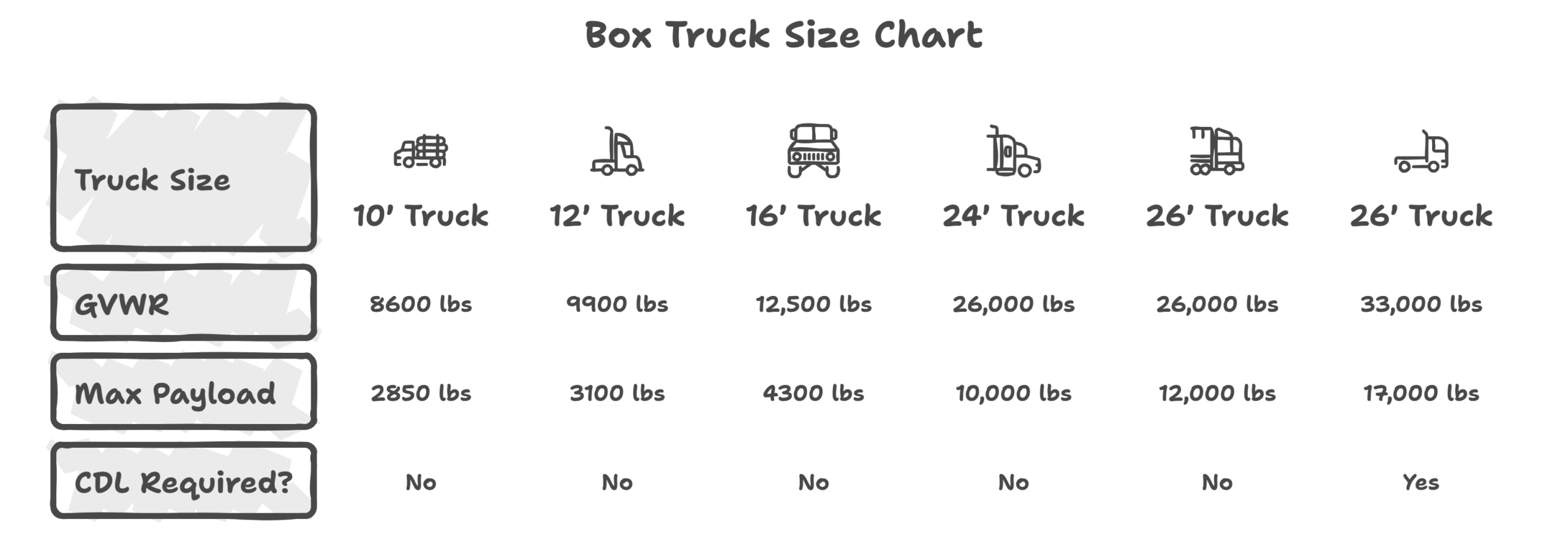
A box truck can carry between 2,850 to 12,000 pounds of cargo, depending on its size. The weight capacity is calculated by subtracting the truck’s empty weight from its GVWR (Gross Vehicle Weight Rating). A 10-foot box truck carries approximately 2,850 pounds, a 16-foot truck carries about 4,300 pounds, and a 26-foot box truck can carry 10,000 to 12,000 pounds of cargo. The exact payload capacity depends on the specific model, truck configuration, and included equipment.
What is the weight capacity?
Weight capacity refers to the maximum amount of cargo a box truck can safely carry. It’s calculated using this formula: GVWR – Curb Weight = Gross Payload Capacity. For example, if a truck has a 16,000-pound GVWR and weighs 10,000 pounds empty, the weight capacity is 6,000 pounds. This number must include the driver, passengers, fuel, and all cargo. Always check the door jamb sticker for your specific truck’s GVWR to determine accurate weight capacity.
How much does a 26 foot box truck weigh?
A 26-foot box truck weighs between 12,500 to 16,000 pounds when empty (curb weight). The total weight when fully loaded can reach up to 26,000 pounds, which is the standard GVWR for non-CDL trucks. This means a 26-foot box truck can carry approximately 10,000 to 12,000 pounds of cargo. The exact empty weight varies by manufacturer and features like liftgates, which add 400-800 pounds to the base weight.
What is a box truck?
A box truck is a commercial vehicle with a cube-shaped cargo area attached to the truck chassis. Also called a cube truck or straight truck, it features an enclosed cargo box separate from the driver’s cab. Box trucks range from 10 to 26 feet in length and are commonly used for moving, deliveries, and junk removal. Unlike semi-trucks, the cargo area and cab are one unit. They don’t require a CDL when the GVWR is 26,000 pounds or less, making them popular for small businesses and rental services.